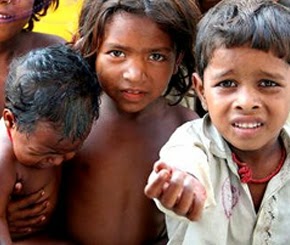
Who is a 'street child'?
There is no international agreement on the definition of
‘street children’, and the label of ‘street children’ is increasingly
recognized by sociologists and anthropologists to be a socially
constructed category that in reality does not form a clearly defined,
homogeneous population or phenomenon.
UNICEF developed the earliest definitions and categories of street children:
Children of the street
(street-living children), who sleep in public spaces, without their families
Children on the street
(street-working children), who work on the streets during the day and return to their family home to sleep
Street-family children
who live with their family on the street .
How many are there?
Estimating numbers of ‘street children’ is fraught with difficulties.
In 1989, UNICEF estimated 100 million children were growing up on
urban streets around the world. 14 years later UNICEF reported: ‘The
latest estimates put the numbers of these children as high as 100
million’. And even more recently: ‘The exact number of street children
is impossible to quantify, but the figure almost certainly runs into
tens of millions across the world. It is likely that the numbers are
increasing’.
What about girls ?
In many cultures, there is much greater pressure for girls to stay at
home than boys. Research shows that girls will put up with abuse at home
for longer than boys but that once girls make the decision to leave
home, the rupture is more permanent than for boys. Girls are also less
visible on the streets as they are often forced or lured into brothels
and prostitution.
What about their rights?
The UN Convention on the Rights of the Child (UNCRC) applies to all
children under the age of 18, including children living and working on
the street. Although street children’s rights are continually violated
or overlooked, they are in ever greater need to have their rights
realised.
A street environment is an extremely dangerous place to be for any
child, and probably no other environment contributes more to potential
violations of the UNCRC than a childhood and youth spent outside the
institutional framework of family, community and school.
What do governments do to help street children?
The UNCRC sets out a framework for protection that emphasises the
family and community as having the main responsibility of caring for
children (Art. 5 and 18). The role of the state is to support and
enable families and communities to fulfil this role. However, it is an
unfortunate fact that in many cases families and communities are not
able to be protective and nurturing. In these cases, as for children
living on the streets, the state then takes on a greater responsibility
to fill the gap (Art. 20: “A child temporarily or permanently deprived
of his or her family environment shall be entitled to special
protection and assistance provided by the State”).
Unfortunately, this is often not the case. Although many governments
try to address the issue of street children there is a real lack of
long-term, sustainable and holistic approaches implemented by
governments. This is partly due to lack of resources and interest, or a
failure to understand how to deal with the issue in a positive way
which does not violate the rights of street children.
 Jonny is a charming 15 year old boy since Aug. 26 with us. He has
Down syndrome and Hepatitis-B with speech difficulties. He loves
dancing, choreographs his own steps, learns to copy immediately having
seen any steps. He is the disco dancer of Snehalaya. His favorite
passtime is eating and talking on imaginary mobile phone. He is hard
working and keen to help his carer parents in looking after the children
in the cottage where he lives with them.